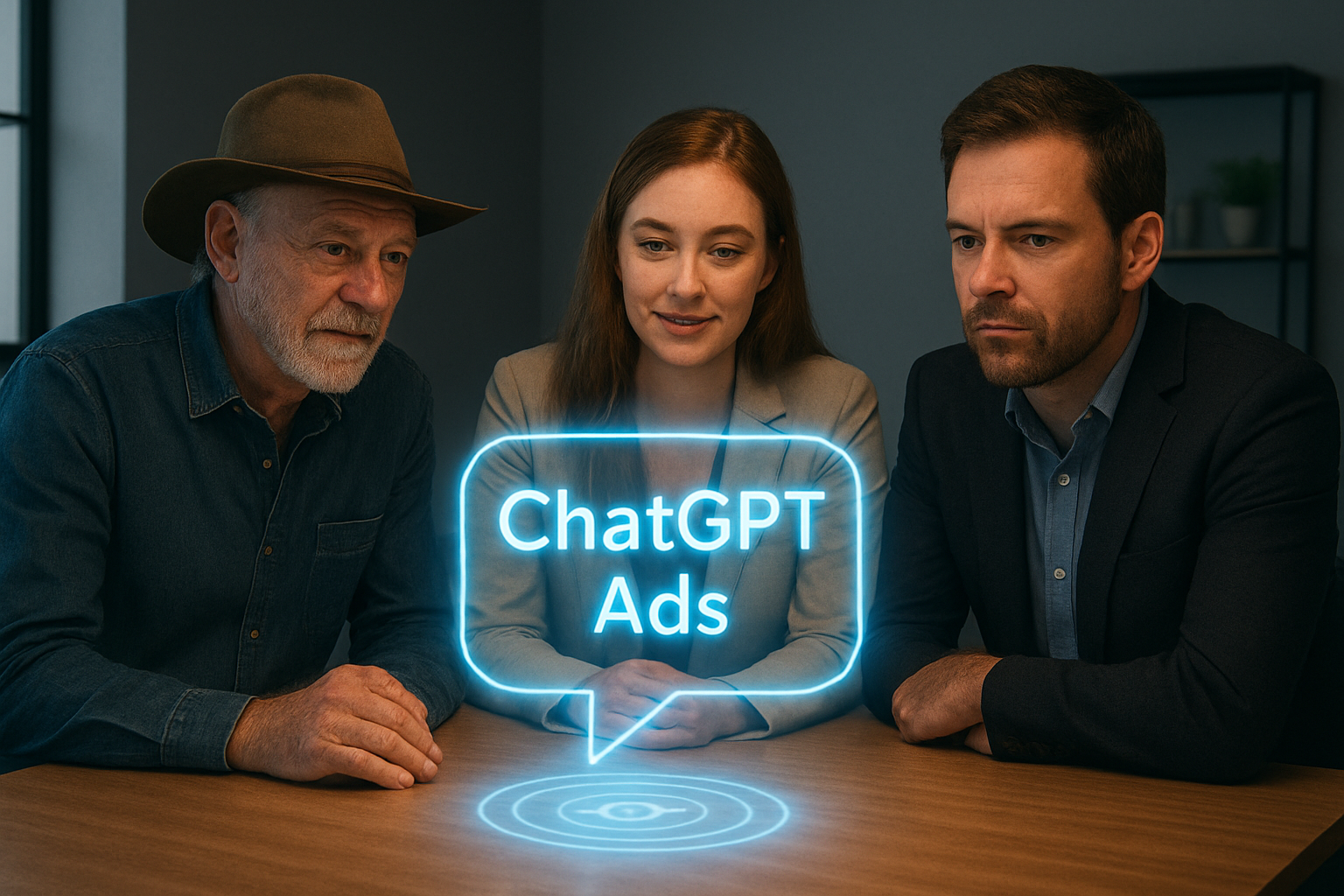
Last year, OpenAI’s ChatGPT crossed a threshold. It stopped being just a tool people used to write emails, summarise documents or settle arguments at dinner. It became something closer to an intermediary: a system people increasingly trust to answer questions, make recommendations and guide decisions, part of a broader shift in
how artificial intelligence is reshaping modern marketing.
Ask ChatGPT which laptop to buy. Ask which project management software fits a 10-person team. Ask it how to plan a vacation, what CRM to use, or which brand of running shoes is best for bad knees. In many cases, the answer now replaces a Google search, a review site, or a visit to a brand’s homepage.
For marketers, that shift is existential.
If ChatGPT and other large language models embedded into search engines, operating systems and shopping platforms become the primary interface between consumers and products, then persuasion no longer happens on landing pages, ad units or social feeds. It happens inside a model’s response.
And brands are scrambling to prepare.
For now, ChatGPT does not directly sell products. It does not process payments or show sponsored listings in the traditional sense. But it already does something just as powerful: it shapes consideration. It decides which brands are mentioned, which are ignored and which are framed as trustworthy, risky, premium or outdated.
That alone is enough to force a rethink of modern marketing.
In the past, marketers focused on ranking in search results, optimizing conversion funnels and crafting messages for human readers. In a world where A.I. agents summarize markets on behalf of users, the audience is no longer just a person. It is a machine trained on language, patterns and probability.
“The moment people start asking an A.I. what to buy instead of where to buy it, the rules change,” said one marketing executive at a global consumer brand, who requested anonymity to speak candidly. “You’re no longer competing for clicks. You’re competing for inclusion.”
So how does ChatGPT decide what to recommend, and what does that mean for companies trying to sell through it? Here’s what to know.
How ChatGPT influences buying decisions
When a user asks ChatGPT for advice, the model does not search the web in real time by default. Instead, it generates an answer based on patterns learned during training, reinforced by system-level updates, safety rules and, in some cases, curated data sources.
That means brand visibility inside ChatGPT is shaped by factors marketers do not fully control: how often a brand appears in credible contexts online, how consistently it is described, what attributes are associated with it and whether it is framed positively or negatively across sources.
In practice, ChatGPT tends to favor brands that are well-documented, frequently discussed and clearly positioned. Vague messaging, thin content and inconsistent descriptions work against inclusion. So does jargon-heavy marketing language that obscures what a product actually does.
Marketers are
already testing this. Ask ChatGPT to recommend email marketing software, accounting tools or endpoint security platforms, and you will notice a pattern. The same brands appear repeatedly. Others, sometimes equally capable, are absent.
If a brand does not exist clearly in the model’s learned representation of the world, it effectively does not exist to the user.
Why this threatens traditional marketing channels
For decades, digital marketing has been built around intermediaries: search engines, social networks, marketplaces and publishers. Brands learned how to play those systems through search engine optimisation, paid media and content marketing.
ChatGPT collapses many of those layers into a single conversational interface.
Instead of ten blue links, the user gets one answer. Instead of scrolling through reviews, the user gets a summary. Instead of comparing pricing tables, the user gets a recommendation.
That compression is brutal.
This is especially disruptive for categories where buyers rely on research: software, financial products, health tools, education and professional services. These are exactly the domains where people already turn to ChatGPT for explanations.
It also undermines performance marketing models built on attribution. If a purchase decision is influenced by an A.I. recommendation that leaves no referral data, marketers lose visibility into what drove demand.
The funnel still exists. It is just harder to see.
How marketers are adapting
In response, a new discipline is emerging inside marketing teams, sometimes called “A.I. optimisation” or “LLM optimisation.” The goal is simple: increase the likelihood that a brand is
accurately and favorably represented inside generative models.
In practice, that means doing some old things better and some new things entirely.
First, clarity matters more than cleverness. Brands are rewriting product descriptions, documentation and thought leadership to be explicit about what they do, who they serve and how they differ. Ambiguity confuses models just as much as it confuses people.
Second, authority signals matter. Mentions in reputable publications, academic research, technical documentation and expert commentary carry disproportionate weight. Not all content is equal in how it shapes a model’s understanding.
Third, consistency is critical. If a brand describes itself differently across its website, press coverage and third-party reviews, the model may average those descriptions into something incoherent.
Some companies are now running internal tests, prompting ChatGPT with common buyer questions and auditing the answers as if they were search results. When the output is wrong or incomplete, teams work backward to identify gaps in public information.
What this means for consumers
From the consumer’s perspective, A.I.-mediated shopping feels easier. Less research. Fewer tabs. Faster answers.
But it also concentrates power.
If a small number of models become trusted arbiters of taste, quality and value, their biases — intentional or not — shape markets. Products that are easier to describe, easier to categorize or already popular gain an advantage. New entrants face a steeper climb.
There is also a risk of homogenisation. If models tend to recommend the same “safe” options, innovation at the edges becomes harder to surface.
Regulators and platform builders are aware of these concerns, but there are few clear rules yet. Disclosure, transparency and commercial influence inside A.I. systems remain open questions.
For now, consumers should treat A.I. recommendations as starting points.
The future: when ChatGPT actually sells
Today, ChatGPT influences decisions. Tomorrow, it may complete them.
It is not hard to imagine a version of the interface that lets users buy directly inside the conversation, whether through integrations with retailers, affiliate relationships, or native checkout flows. At that point, ChatGPT would not just recommend products. It would be a storefront.
When that happens, marketing will look less like advertising and more like negotiation with an algorithm.
Brands that prepare now — by being legible, credible and genuinely useful — will be better positioned when the model becomes the marketplace.
The rest may discover too late that in a world where consumers ask A.I. what to buy, silence is the same as irrelevance.